 HOA Law Blog
SWEDELSONGOTTLIEB
Community Association Attorneys
SB 1007: The Bill That Could Defund Your HOA



SWEDELSONGOTTLIEB
Community Association Attorneys
SB 1007: The Bill That Could Defund Your HOA
By: The Attorneys at SwedelsonGottlieb
 As it does just about every year, the California Legislature has made changes to the law impacting community association’s statewide. This article covers those changes effective January 1, 2023 and other recent changes in the law that are worthy of being mentioned, as they may apply to your California community association. We have included examples of the application of the new law.
Outline of what is covered in this article:
 The United States Equal Employment Opportunity Commission (“EEOC”) recently created a new webpage with helpful practical information to guide employers and employees about employment discrimination based on sexual orientation and gender identity. This new webpage provides additional clarity about sexual orientation and gender identity protections based on the 2020 Supreme Court decision in Bostock v. Clayton County (decided on Jun. 15, 2020). In Bostock, the Supreme Court held that those firing individuals because of their sexual orientation or transgender status violated Title VII’s prohibition on discrimination because of sex. Title VII is part of the Civil Rights Act of 1964, a national law that prohibits employment discrimination based on protected classes of people such as race, color, religion, sex, and national origin.
The new webpage is intended to function as one comprehensive resource to educate employees, applicants, and employers about the rights of all employees, including lesbian, gay, bisexual, and transgender workers, to be free from sexual orientation and gender identity discrimination in employment. In addition, the new webpage includes information on related topics of harassment and retaliation. Although Title VII and Bostock only apply to employers with 15 or more total employees and does not generally apply to independent contractors, associations with any employees can still learn best practices from these new EEOC resources to prevent discrimination (and liability) in the workplace.
We share below some important reminders and takeaways from the recently published resources:
Prepared by the Community Association Attorneys at SwedelsonGottlieb
Senate Bill 323, proposed new law that would impact how California community association conduct elections, was approved by the Senate and Assembly was presented to Governor Newsom for his signature. This proposed legislation will impact and change the procedural requirements for most California community associations’ elections. Unfortunately, this proposed legislation goes too far and it is not the right solution to whatever it is that motivated Senator Wieckowski to author this new legislation.
For example, under current law, Civil Code Section 5200(a)(9), members of a community association can request their association’s list of members, including the members names and addresses. Currently Civil Code section 5220 allows members the ability to opt out and keep their contact information, which they deem private, off the list. SB 323 includes a loophole that effectively eliminates the ability for owners to opt out of having their name and personal contact information provided to another member. This proposed new law requires owners to provide their name and address on the envelope that includes the ballot, which SB 323 would make part of the list of records available for member inspection.
From the Community Association Attorneys at SwedelsonGottlieb 
It is no secret that community associations are often targets for embezzlement. But they are not alone. Newspaper articles tell us that it happens to various types of businesses and organizations, even attorneys and lawyer/bar organizations. Fraud and embezzlement seems more likely to occur when no one is watching those that control the checkbooks. And unfortunately, many many condominium, stock cooperative and planned development boards of directors become too trusting and they don’t keep an eye on what their manager or treasurer are doing.
To ensure that community associations are better protected, the California legislature passed AB 2912, acknowledging that associations are susceptible to fraud and embezzlement, and that more is needed to completely achieve the goal of protecting community association funds. Pay close attention as there are new requirements for both managers and boards amending two sections of Civil Code and adding three new ones. AB 2912 made the following changes to the law:
By the Community Association Attorneys at SwedelsonGottlieb 
Through SB 261, the California Legislature fixed some issues with prior legislation dealing with delivery of notices and related matters and generally fixed some issues that had come up after prior legislation was adopted. This bill became effective in January 1st and amends the following existing sections of the Civil Code as stated:
• Email Consent to Document Delivery — Civil Code §4040 (Individual Notice), which allows for individual delivery of notices and other documents by email if an owner consents to this in writing was amended to allow an individual owner to permit/revoke consent to allow individual notice by email. While most attorneys thought that an email was considered a writing, this amendment eliminates any confusion.
 A senate bill seeking to prohibit California community associations from establishing qualifications for candidates to run for their boards of directors among other changes and requirements (including possible invasion of owner privacy) is a dumb idea that would create bad law.
On April 5th, Los Angeles Times’ Sacramento columnist George Skelton noted that the California legislature passed nearly 1,000 bills in 2017: “A few were important. Most were not. Many were frivolous, some dumb – a waste of politicians’ time and public money. . . There are many bills pending in the legislature again this year that the state could do just fine without.”
One bill I think the State could do just fine without is SB1265. And if you live in a California community association, I think you’ll agree. You should IMMEDIATELY let the legislature know that this legislation is unnecessary, and that the State could do just fine without SB1265. Let me explain how I and many others in the industry came to this conclusion.
By Joseph L. Gilman, Esq., Associate at SwedelsonGottlieb, Community Association Attorneys
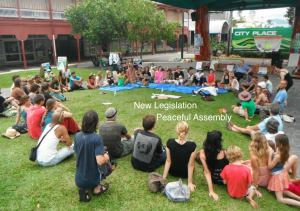 Effective January 1, 2018, Civil Code Section 4515 was added to the Davis-Stirling Act to protect certain rights of political speech and peaceful assembly within the boundaries of a common interest development.
Senator Bob Wieckowski originally presented new Civil Code Section 4515 to California’s legislature as Senate Bill 407. Remarking on his proposed legislation, Senator Wieckowski stated that it “will prevent HOA boards and management from denying basic rights to their residents” as “Boards have fined and threatened legal action against homeowners for simply exercising basic political free speech rights. Millions of Californians live in these associations and SB 407 is needed to prevent these abuses.” While we have no experience with these types of “abuses,” we understand the basis for this new legislation.
As enacted by California’s legislature, Civil Code Section 4515 (which became effective January 1, 2018) protects political speech and assembly rights by invalidating any provision of an association’s governing documents (which includes rules) that prohibits the following:
• Peacefully assembling or meeting, at reasonable hours and in a reasonable manner, for purposes related to common interest development living, association elections, legislation, election to public office, or the initiative, referendum or recall process.
• Inviting public officials, candidates for public office, and representatives of homeowner organizations to meet with members and residents and speak on matters of public interest.
• Canvassing and petitioning the members and residents for purposes related to the topics listed above.
• Distributing or circulating, without prior permission, information about the topics listed above or other issues of concern to the members or residents, at reasonable hours and in a reasonable manner.
Civil Code Section 4515 also invalidates any provision requiring a member or resident to pay a fee, make a deposit, obtain liability insurance, or pay the premium or deductible on the association’s insurance policy, in order to use a common area for any of the meetings described above. Continue reading
By Nicholas Marfori, Esq. and David Swedelson, Esq., Community Association Attorneys at SwedelsonGottlieb
 As you may have heard, the Governor signed into law new legislation that now changes a California condominium’s associations ability to prohibit an owner from installing a solar energy system on the common area roof. AB 634, which went into effect on January 1, 2018, amended several provisions of the California Civil Code to set forth language that further clarifies what condominium associations can and cannot do with respect to the installation of an owners own solar energy system on a common area roof and exclusive use common.
As originally enacted, Civil Code § 714 and § 714.1 already prohibited associations from imposing unreasonable restrictions against the installation of solar energy systems on common areas and on a separate interest owned by another owner. AB 634 amends Civil Code § 714.1 to further clarify that associations are prohibited from doing the following:
By Sandra Gottlieb, Esq. CCAL, Senior/Managing Partner, SwedelsonGottlieb, Community Association Attorneys
 Recent legal Developments affect community association interests in a variety of ways. In 2017, the California Court of Appeal decided several cases concerning such issues as title to common area and board member liability. These cases may be instructive to board members and managers. Meanwhile, on the legislative front, new and pending laws affect association interests in the areas of governance, business dealing, FHA certification, annual notifications and use restrictions. Though not a complete or authoritative guide, we hope this article (published in the Winter 2017 Volume 10, Issue 1 of the Communicator, Community Association Institute/Bay Area/Central California Chapter’s news magazine) can be a useful resource for the most relevant legal updates this year. Follow this link or click here to download the article.
Sandra Gottlieb is a community association legal expert who has devoted her practice and that of SwedelsonGottlieb to the representation of California CIDs and HOAs. She can be contacted via email at slg@sghoalaw.com