



 From all of us at SwedelsonGottlieb, we hope you have had a joyous holiday season, and we wish you much success in the New Year!
Knowing that one of your New Year’s Resolutions is to learn and understand the new Davis-Stirling Common Interest Development Act (and if you are unsure as to what new Act we are referring to, follow this link for our article “The New Davis-Stirling Act: Get Ready”). We have also prepared a new article that discusses and explains the major changes in the New Act.
Yes, most of the language of the old Act has not changed in the new Act. But some of it has, and those changes are significant. What has really changed are the code sections themselves; longer code sections have been broken up into smaller and shorter code sections, and code sections have been reorganized so they are in a more logical order. And there have been some significant changes in the Act which you should know and understand.
 In March of 2012, we reported on a lawsuit in Hawaii where the jury awarded $3.87 Million to a couple of condo owners In Molokai.
  In the last year, prices for detached single-family dwellings have skyrocketed in Los Angeles. “A single-family house with a backyard is . . . a luxury,” mourned a 34-year-old financial analyst. No wonder “Southland Buyers Shift to Condos,” as an article in the Los Angeles Times put it.
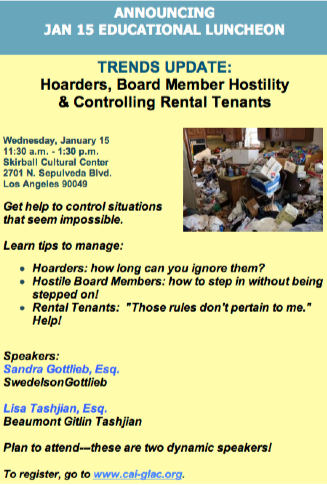 Sandra Gottlieb will appear as a co-presenter on the CAI-GLAC’s luncheon program,
  The body of statutory law (as opposed to case law) governing California Community Associations, known as the Davis-Stirling Common Interest Development Act, went into effect on January 1, 1986. As the industry developed and matured over the last 27 years, approximately 50 changes and amendments were made to the Act. While those adjustments were well-intended, the net effect yielded a disorganized and confusing body of law. To address this problem, a multi-year effort was launched to rewrite the Davis-Stirling Act. This “new” Davis-Stirling Act, signed into law in 2012, becomes the guiding law for California residential community associations on January 1, 2014. So you are probably asking what are the major changes and how does the re-write affect reserve funding issues? The answer is no major changes have been made regarding reserve funding. For the most part, the new updated law amounts to new set of Civil Code references for reserve funding matters. Fortunately, the majority of the changes are just re-organization and renumbering. But there have been changes made to the Act as it applies to reserves.
 San Rafael, a city just north of San Francisco, recently made active a smoking ban which prohibits smoking cigarettes inside any dwelling that shares a wall with another unit and this would include condominiums. It is considered the strictest smoking ban in the country.
  How clear is your writing? Do you spend time editing to make sure that your message is clear and concise? Are your communications rambling? Sometimes community association managers or board members think that writing in legalese will impress their attorneys. Or that using long, technical or sophisticated words will sway homeowners to action. Long words and too many of them can make all of us feel like we’re spinning around in the endless loop of the old Abbott and Costello “Who’s On First?” routine. How do you get off that not-so-merry-go-round?
 At some point, just about every community association will have a delinquent owner who files for bankruptcy. And while a bankruptcy filing is often interpreted as meaning that the debt has become uncollectable, it does not necessarily mean the end of the road for creditors, especially homeowners associations. There are special provisions for homeowners associations in the Bankruptcy Code that may help an association, assuming the association has recorded a lien, and collection of the delinquent assessments may still be possible. Having an attorney who is familiar with bankruptcy law involved at the outset of the case can drastically improve an association’s chances of recovering the money it is owed. Some bankruptcies are quick and easy. Some are not. Some start out looking like they will be quick and easy, and then things change. This article is about the ones that change when a delinquent homeowner’s bankruptcy is converted from one type of bankruptcy to another.
 According to an article in the Tuesday, November 5, 2013 edition of the Los Angeles Times